

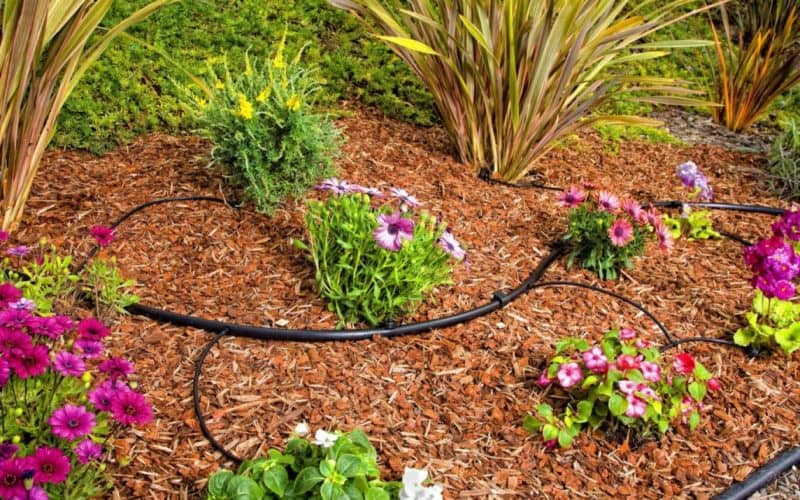
Why Garden Watering Is Different From Lawn Watering
Lawns tolerate inconsistency. A lawn that misses one watering event goes dormant briefly — it recovers. Vegetable gardens do not have the same buffer. Missing two days of water during a heat wave turns flowering tomato plants into non-producing plants. Missing a week turns them into dead ones.
Garden watering is also more complex because you're managing multiple plant types with different water needs in close proximity. The cucumber at one end of the bed might need daily water; the rosemary at the other needs to dry out between waterings or it will rot.
This guide organises watering by plant category, not by a universal schedule.
Watering by Plant Category
Vegetables — High and Variable Need
| Vegetable | Water need | Frequency (summer) | Depth |
|---|---|---|---|
| Tomatoes | High | Daily or every other day | 6–8 inches deep |
| Cucumbers | High | Daily | 6 inches deep |
| Peppers | Medium-high | Every 2 days | 6 inches deep |
| Courgette/squash | High | Every 2 days | 6–8 inches deep |
| Corn | Very high (tasselling) | Daily during tasselling | 8 inches |
| Beans | Medium | Every 3–4 days | 4–6 inches |
| Lettuce | Medium-low | Every 2–3 days, light | 2–3 inches |
| Spinach | Low-medium | Every 3–4 days | 2–3 inches |
| Herbs (basil, parsley) | Medium | Every 2–3 days | 3–4 inches |
| Herbs (rosemary, thyme, sage) | Low | Weekly or less | Allow to dry between |
Flowers — Wide Range
| Type | Water need | Frequency |
|---|---|---|
| Annual bedding plants (petunias, impatiens) | High | Every 1–2 days in heat |
| Perennials (established) | Low-medium | Weekly once established |
| Roses | Medium-high | Every 2–3 days in summer |
| Lavender | Very low | Every 2–3 weeks |
| Dahlias | Medium-high | Every 2 days during growth |
| Succulents / cacti | Very low | Every 2–4 weeks |
Trees and Shrubs
Newly planted trees and shrubs need intensive watering for the first 1–2 years while root systems establish. Established trees rarely need irrigation except in drought.
| Stage | Frequency | Method |
|---|---|---|
| Newly planted (weeks 1–4) | Every 2–3 days | Water at the root ball |
| Establishment (months 2–12) | Weekly | Slow, deep water at drip line |
| Established (year 2+) | Rarely, drought supplemental | Deep infrequent watering |
Containers — Most Demanding
Container plants are the most water-intensive plants in any garden. They have no access to groundwater, dry out far faster than in-ground plants, and suffer immediately when water-stressed.
General rule: In summer, most containers need daily watering. In a heat wave (>95°F), twice daily. A container that feels light when you lift it is likely water-stressed. Signs a container needs water:- The soil surface looks dry and pulls away from the container edges
- Leaves begin to wilt (act before this happens — wilting causes permanent cell damage in some plants)
- The container feels noticeably lighter than when fully watered
Seasonal Watering Schedules by USDA Zone
Zones 3–5: Short Season
| Season | Vegetables | Flowers | Trees |
|---|---|---|---|
| Spring (May–June) | Every 2–3 days | Every 2–3 days | Weekly |
| Summer (Jul–Aug) | Daily or every other day | Every 1–2 days | Every 2 weeks |
| Fall (Sep–Oct) | Reduce; harvest | Reduce | Monthly if dry |
Zones 6–7: Temperate
| Season | Vegetables | Flowers | Trees |
|---|---|---|---|
| Spring (Apr–May) | Every 2–3 days | Every 2–3 days | Weekly |
| Early summer (Jun) | Every 2 days | Every 2 days | Bi-weekly |
| Peak summer (Jul–Aug) | Daily or every other day | Every 1–2 days | Every 2 weeks |
| Fall (Sep–Oct) | Reduce | Reduce | Monthly |
Zones 8–9: Warm
| Season | Vegetables | Flowers | Trees |
|---|---|---|---|
| Cool season (Nov–Mar) | Every 2–3 days | Every 2–3 days | Monthly |
| Spring/Fall | Every 2 days | Every 2 days | Every 2 weeks |
| Peak summer (Jun–Sep) | Daily | Every 1–2 days | Weekly |
Zones 10–13: Tropical/Arid
In very hot zones, timing matters as much as frequency. Water in early morning (before 8am) or evening (after 7pm) — midday watering loses 25–40% to evaporation before it reaches roots.
Year-round watering is the norm. Drip irrigation is strongly preferred over overhead sprinklers for all garden plants in these zones.
Signs of Underwatering vs Overwatering
Underwatering signs
- Wilting during the heat of the day — plants are losing water faster than roots can supply it. Not always serious (some plants wilt at midday and recover by evening) but watch for it.
- Wilting in the morning — this is serious. Morning wilt means the plant couldn't recover overnight. Water immediately.
- Leaf curl inward — the plant is reducing surface area to limit water loss
- Dry, crumbly soil below the surface — use a finger to check 2–3 inches down
Overwatering signs
- Yellow leaves — especially lower leaves; often indicates root oxygen starvation
- Mould or fungal growth on soil surface
- Soft, mushy stem bases — early root rot
- Gnats flying from soil — fungus gnats breed in wet soil
Putting It All Together: Smart Controller for the Garden
The most reliable garden watering system:
The Rachio 3 supports up to 16 zones and explicitly supports drip/garden zone types with appropriate ET calculations. For a serious vegetable garden, the time saved and consistency gained justify the $179 cost within one season.
Full drip irrigation setup guide → Smart controller comparison →Related guides: