

Quick Verdict
The Rain Bird 32ETI is the best complete in-ground sprinkler kit for most homeowners with lawns between 1,500 and 5,000 sq ft. The pop-up rotor heads are built to contractor spec — rated for 15+ year lifespan — and the system pressure is consistent across all heads even on uneven terrain. At $89–$109, it's also significantly cheaper than comparable Hunter or Orbit in-ground kits.
Best for: Zones 4–9, lawns 1,500–5,000 sq ft, DIY installs and contractor jobs alike. Not for: Very large properties (1 acre+), Zones 1–3 without freeze-rated valves added separately, pure drip irrigation setups. Check current price →Why Rain Bird Has a Strong Contractor Reputation
Among irrigation professionals, Rain Bird has a long-standing reputation summed up bluntly in one contractor's words on a sprinkler-trade forum: "Rain Bird stuff just works" — and across professional discussion, reliability is described as close across the major brands at the commercial product tier, with Rain Bird and Hunter the two most commonly recommended. Two practical reasons come up repeatedly:
What's Actually in the Box
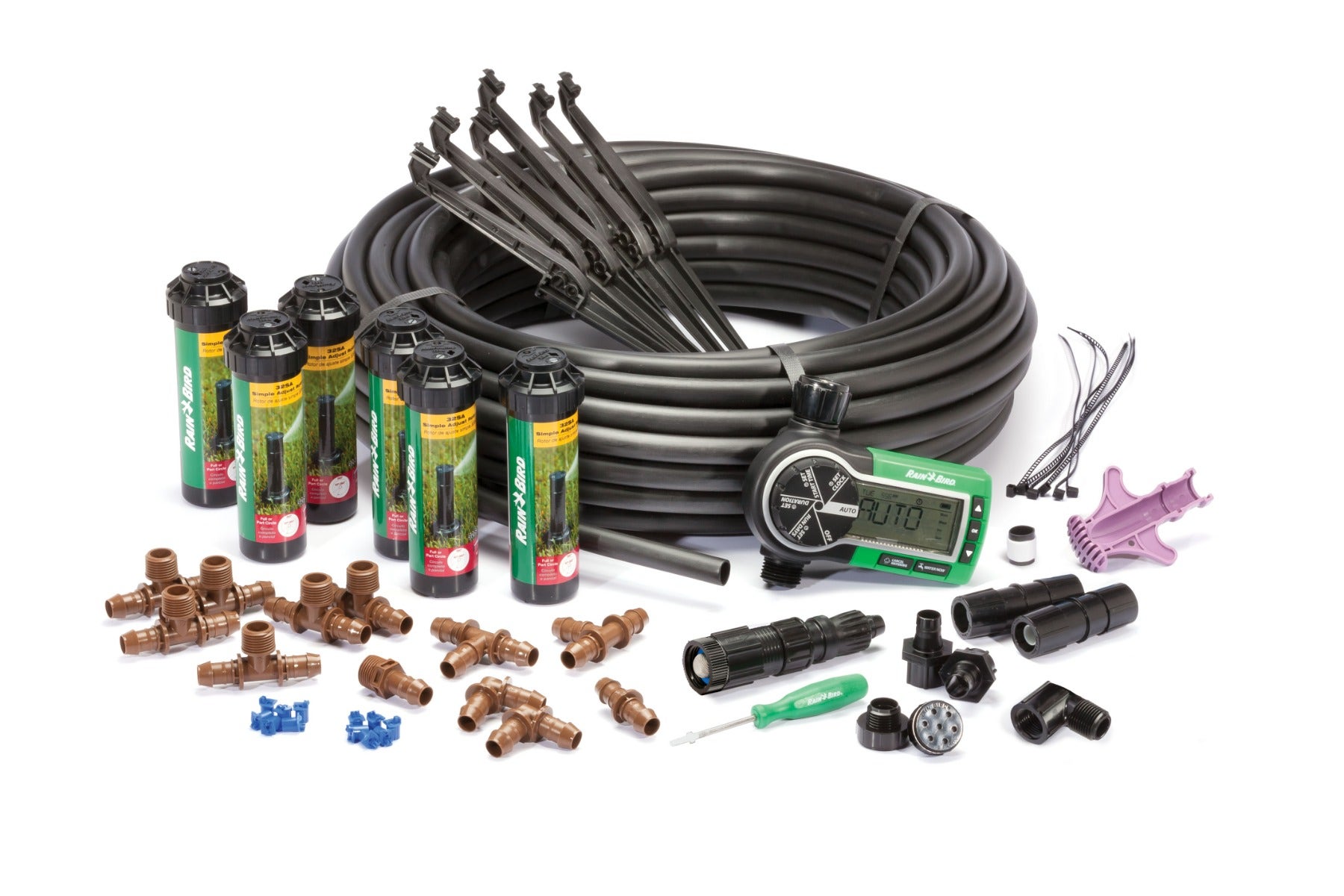
Per Rain Bird's own product listing, the 32ETI kit includes:
- 6 x Rain Bird 32SA rotary pop-up heads (adjustable arc, 0.75 GPM pre-installed nozzle)
- 12 extra nozzles (six 1.0 GPM, six 1.5 GPM) for adjusting flow per head
- 1 x mechanical timer/controller
- 125 ft of tubing, fittings, drain valves, install stakes, tool kit, and PTFE tape
Key Specs
| Spec | Rain Bird 32ETI |
|---|---|
| Coverage area | Up to 3,000 sq ft |
| Head type | Pop-up rotor, adjustable arc (32SA) |
| Recommended pressure | 40–75 PSI, minimum 6 GPM flow |
| Controller | Mechanical timer (not smart) |
| USDA zones | 4–9 (freeze-rated valves needed separately for 3–4) |
| Install difficulty | Moderate DIY |
| Interested in Rain Bird 32ETI Complete Sprinkler System Kit?Check current price | |
What Verified Buyers Actually Report
Across Amazon customer reviews and independent review sites, a consistent pattern emerges:
What people like: once installed correctly, the system noticeably cuts down on wasted water versus hand-watering or an old fixed timer, the rotor heads are durable, and coverage is consistent across zones. What people complain about: the included mechanical timer is the weak point — the most frequently reported failure is the timer's internal plastic manifold cracking after a summer of heating/cooling cycles, which can leak and eventually short the solenoid. Some buyers also report receiving kits missing the extra nozzle set. Neither issue affects the rotor heads themselves, which is consistent with the kit's "heads are the strong part, included timer is the weak part" reputation.Heads: The Reason Contractors Specify Rain Bird
Rain Bird's 32SA pop-up rotor heads are the standout component of this kit. Two things come up repeatedly when buyers and contractors compare them to budget Orbit equivalents:
1. Arc adjustment that holds: a recurring theme in Orbit product reviews is that the arc setting on cheaper rotor lines drifts back toward 360° over time; this isn't a commonly reported issue for Rain Bird's equivalent heads. 2. Replacement availability: the Rain Bird 1800 series (used in this kit) is a genuine industry standard stocked at most hardware stores and irrigation suppliers — exact replacements typically run $3–5 per head.The Controller: Honest Assessment
The included mechanical timer is functional but basic — no Wi-Fi, weather intelligence, or remote control. It's also the part most frequently flagged in buyer reviews as a failure point (see above).
Our recommendation: install the included controller to get the system running, then upgrade to a Rachio 3 or Orbit B-hyve when your budget allows. The 32SA heads run on standard 24V AC and are compatible with any third-party controller — swapping is a straightforward job.Upgrading to a smart controller like the Rachio 3 adds EPA WaterSense-backed water savings (see our Rachio 3 review) on top of the Rain Bird hardware — the heads are efficient, but a smart controller makes scheduling meaningfully smarter.
Installation: What to Expect
This is a moderate DIY job. If you're comfortable with basic plumbing (cutting pipe, threading fittings) and renting a trencher, allow:
- 1/4 acre lawn, 3-zone install: 4–6 hours including trenching
- 1/2 acre lawn, 5-zone install: 8–12 hours, or hire out
Pros and Cons
- Rotor heads are a genuine industry standard, widely stocked for easy replacement
- Arc-drift is a recurring complaint on cheaper competitor heads, but not commonly reported for this line
- Compatible with any 24V smart controller — straightforward upgrade path
- Cuts water waste noticeably once installed, per verified buyer feedback
- Cheaper than comparable Hunter kits at similar coverage
- Included controller is basic — no weather intelligence or remote access, and is the most commonly reported failure point
- Does not include anti-siphon valves required by most local codes
- Coverage rated up to 3,000 sq ft — larger lawns need additional heads/zones
- Not freeze-rated out of box for Zones 3–4 (add anti-freeze valves separately)
- Installation requires trenching — a rented trencher or professional labor needed
Rain Bird 32ETI vs the Competition
vs Orbit 58322 (~$79): Orbit is cheaper, but arc-drift on budget rotor heads is a recurring theme in Orbit buyer reviews. For an install you want to last, the price gap is worth it. vs Hunter PGP Rotor Kit (~$140): Hunter and Rain Bird are generally considered close competitors at the contractor tier, with reliability described as "pretty close across the brands" by irrigation professionals. Hunter typically costs more for comparable coverage, making Rain Bird the better value pick for most residential installs. vs smart system bundles: pairing the Rain Bird 32ETI's hardware with a Rachio 3 controller gets you reliable heads plus EPA WaterSense-backed scheduling — a combination worth considering over either product alone. Compare smart bundles →Final Score: 8.8 / 10
The Rain Bird 32ETI earns its contractor-grade reputation on real grounds: the 32SA rotor heads are an industry-standard component with strong buyer feedback, and the brand's reliability reputation among irrigation professionals is well documented. The clearest weakness — confirmed by the most common complaint in verified reviews — is the included mechanical timer, not the heads themselves.
If you're installing an in-ground system for the first time and want rotor heads with a strong track record, this is a reasonable default — just budget for a controller upgrade.
Check current price on Amazon →Related guides:
- Rain Bird vs Orbit — Full Comparison →
- Best Sprinkler Systems 2026 →
- Rachio 3 Review — Best Smart Controller →
- How to Winterize a Sprinkler System →
Sources
- Rain Bird 32ETI — official product page and specs
- Amazon customer reviews — Rain Bird 32ETI
- Sprinkler Talk forum — contractor brand discussion