

Why August needs a fresh calculation
August is not a reason to copy July’s timer settings. Day length is changing, thunderstorms are uneven, soils may repel water after heat, and cool-season turf can be entering dormancy while warm-season turf is still active. The useful question is not “How many minutes?” but “How much water reached the root zone, and how quickly did the soil accept it?”
Measure what your zone delivers
Place six or more straight-sided catch cups across one zone, including dry-looking and normally green areas. Run that zone for 15 minutes. Measure each cup, add the depths and divide by the number of cups. Multiply the average by four to estimate inches per hour. A large spread between cups is a coverage fault; repair or reposition heads before increasing every runtime.
Turn depth into runtime
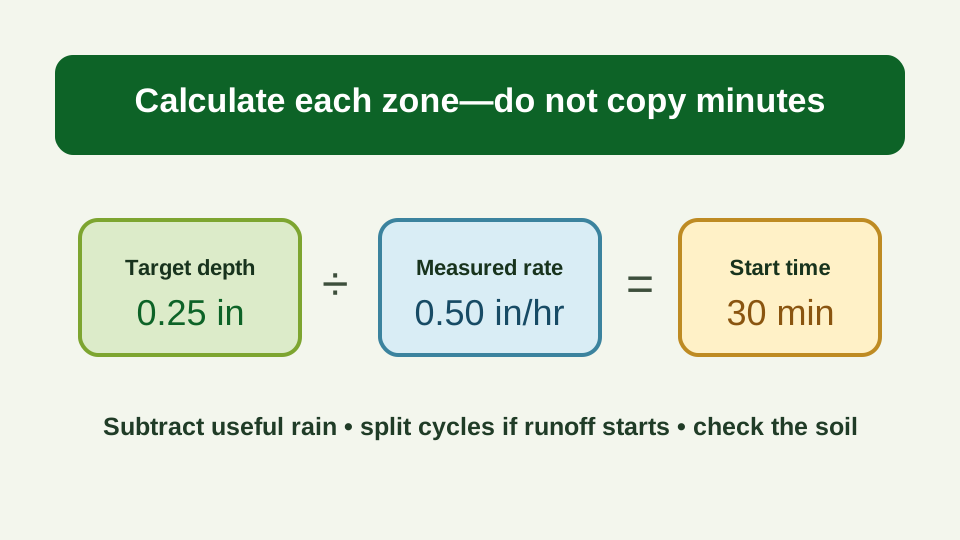
Runtime per event = target depth ÷ measured application rate × 60. If a zone applies 0.50 inch per hour and the target is 0.25 inch, it needs about 30 minutes. This is a starting value, not a promise: subtract effective rainfall and check the soil afterward.
| Measured rate | Depth per event | Starting runtime |
|---|---|---|
| 0.25 in/hour | 0.25 in | 60 minutes |
| 0.50 in/hour | 0.25 in | 30 minutes |
| 0.75 in/hour | 0.25 in | 20 minutes |
| 1.00 in/hour | 0.25 in | 15 minutes |
Adjust for soil, slope and shade
Sand accepts water quickly but stores less, so it may need shorter intervals between events. Clay and compacted slopes often need cycle-and-soak: split one calculated runtime into two or three cycles with a pause between them. Shaded zones usually need less than exposed turf. Never give all zones identical minutes merely because they share a program.
Read the lawn before adding water
Footprints that remain, folded or blue-grey blades and dry soil several inches down indicate water stress. Soft ground, runoff, mushrooms, persistent yellowing or water at the curb indicate excess water or poor distribution. Change one zone by roughly 10–20 percent, then observe it for several days.
Make the controller do less guessing
Weather-aware controllers can skip rain and adjust seasonal percentages, but only when zone type, soil, slope, nozzle and plant data are correct. Review those inputs before enabling automatic schedules. For a conventional controller, use the seasonal-adjust feature and keep a written baseline for each zone.
See the Rain Bird automatic sprinkler kit →A practical August check
- Check local watering-day and drought rules
- Inspect every zone for broken or tilted heads
- Measure output instead of using a generic runtime
- Subtract useful rainfall
- Use cycle-and-soak where runoff starts
- Recheck after major weather changes