
The Short Answer
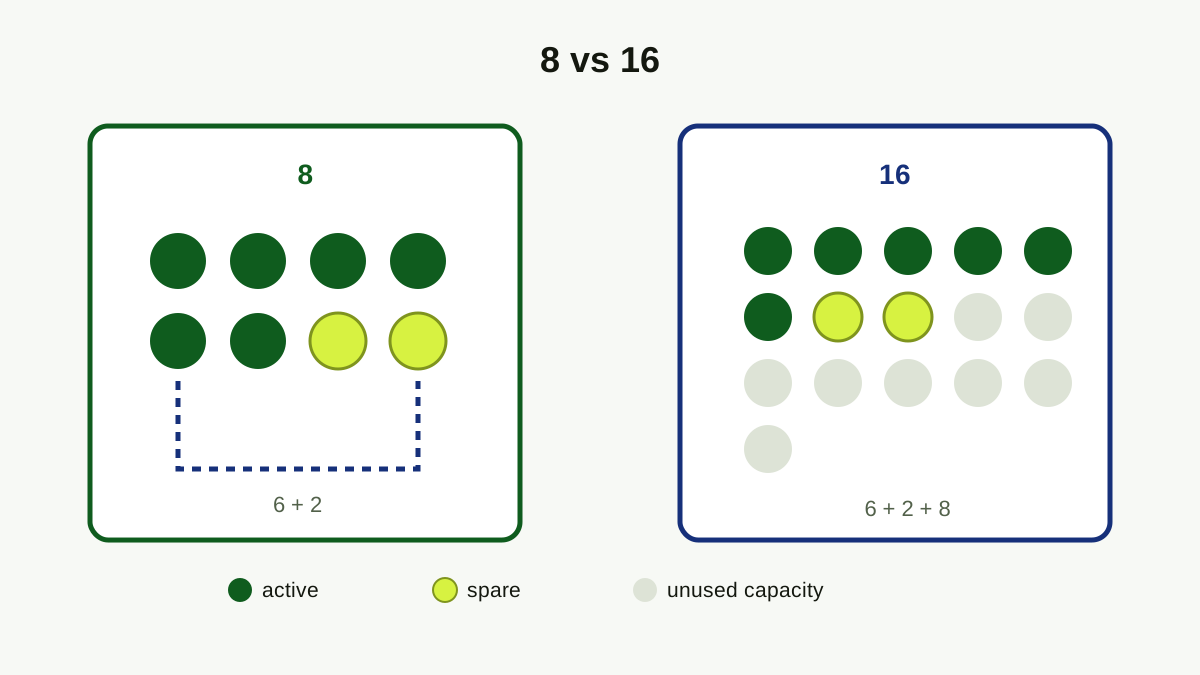
Choose an 8-zone controller when you have six or fewer active valve circuits, one or two verified spare field wires and no credible plan to exceed eight stations. Choose 16 zones when the property already uses nine or more station outputs, a documented redesign will add several valves, or a master valve or pump arrangement consumes capacity on the model you are considering.
Do not buy sixteen merely because the yard is large. Controller capacity counts electrically switched valves, not acres, sprinkler heads or controller programs. Two unused positions are usually sensible; eight or ten unused positions are useful only when there is a real wiring and hydraulic expansion plan.
Count the System Before Comparing Products
Use the zone-mapping worksheet to separate three numbers:
The maximum number printed on the controller is not the active-zone count. An eight-station timer serving six working valves has two positions at the cabinet, but those positions cannot control future valves unless suitable cable and hydraulic capacity also exist in the field.
Capacity Decision Table
| Your verified situation | Sensible direction | Why | Current option |
|---|---|---|---|
| 4–6 active zones, no major redesign | 8 zones | Leaves two to four positions without paying for unused hardware | Compare Rachio 3 8-zone |
| 7 active zones, one small addition likely | 8 zones only after checking the final conductor | One spare position is enough only when the wire and water design support it | Check 8-zone availability |
| 8 active zones and any credible expansion | 12 or 16 zones | An eight-zone replacement has no electrical headroom | Compare Rachio 3 16-zone |
| 9–12 active zones | 12 or 16 zones | Match current valves and retain modest reserve | View Orbit 12-zone |
| 13–15 active zones | 16 zones | Provides current capacity with limited reserve | Check 16-zone option |
| Pump, master valve or special output involved | Verify manual before buying | Models differ in whether the function uses a dedicated terminal or station capacity | Review controller choices |
What Spare Capacity Can—and Cannot—Do
An unused controller terminal is valuable when a matching spare conductor reaches the new valve location and the water supply can support the proposed zone. It can also simplify a later conversion from one oversized mixed zone into separate turf and drip circuits.
It cannot create pipe flow, improve poor pressure, add a conductor inside an existing cable or make an indoor enclosure safe outdoors. If the proposed expansion needs trenching, a larger mainline, another backflow device or substantial valve work, controller price is a small part of the decision.
Does a Master Valve or Pump Use a Zone?
Not always. Many controllers provide a dedicated M, MV or P/MV output, but the exact wiring, current limits and supported relay arrangement are model-specific. Never assume that a 16-zone label means sixteen landscape valves plus any pump arrangement you choose.
Read the installation manual for the exact model and confirm:
- whether a master-valve or pump-start output is dedicated
- whether a relay is required
- whether the output runs with every station or selected stations
- whether simultaneous zones are supported
- whether a flow sensor uses separate terminals
When Eight Zones Is the Better Buy
Eight is usually the cleaner choice for a six-zone residential system. The enclosure is often smaller, the terminal layout is easier to audit and the purchase cost is lower. More capacity does not improve weather data, app reliability, local controls or WaterSense certification.
Compare the models on the features you will actually use:
| Decision | Question to verify |
|---|---|
| Mounting | Is the exact model approved for indoor or outdoor placement? |
| Offline operation | Can you start and stop a station without the app or cloud? |
| Weather response | Is the product WaterSense certified, forecast-based, sensor-based or merely app-adjustable? |
| Sensors | Does it support the rain, flow or soil sensor you already own? |
| Support | Is the manual, warranty and app-update history clear? |
When Sixteen Zones Is Worth Paying For
Sixteen becomes sensible for a large, already-zoned property; a documented landscape redesign; separate turf, tree, shrub and drip circuits; or a phased installation where conduit and multi-core cable have already been sized for expansion.
A useful planning rule is current active circuits plus two realistic additions, rounded up to an available controller size. If that calculation gives ten, compare twelve- and sixteen-zone products rather than forcing the design into eight. If it gives six, sixteen is mostly stranded capacity.
Three Buying Mistakes to Avoid
Counting sprinkler heads
Heads share valves. Forty heads can still be eight zones.
Counting programs as zones
A program is a schedule grouping. Multiple zones can run sequentially under one program; extra programs do not add terminals.
Assuming spare terminals equal easy expansion
Inspect cable routes, flow, pressure and valve locations first. An unused terminal at the garage does not prove a usable conductor reaches the backyard.
Verdict: Buy 8, Buy 16, or Redesign First
| Result | Choose this |
|---|---|
| Six or fewer active valves, no substantiated expansion beyond eight | Buy 8 |
| Eight active valves, nine or more planned circuits, or documented multi-zone expansion | Buy 12/16 |
| Unknown valve count, no spare conductors, mixed emitters or pressure problems | Redesign or diagnose first |